What k9x Origin is
k9x Origin is a framework component, and MCP is one of the ways to reach it, the same way k9x Shield is a component, not a service.
What it is
A class in the framework (K9Origin, in k9_origin) that does the
resolving: scope, Shield checks, live state, read-through, verify, flags. It runs inside your solution's own process,
wherever you build it with OriginFactory.create(config).
| Who asks | How | Example |
|---|---|---|
| Orchestrator | Direct, in-process, no network | Before a squad runs, it fills live_context from origin.yaml |
| Agent (or any MCP client) | Over MCP, through OriginMCPServer | The agent's last-moment get_current before acting |
So "MCP service" describes how agents call it, not what it is. OriginMCPServer is the thin MCP
wrapper that carries the calls; all the logic is in K9Origin.
How it is deployed
- In K9X Streams: Origin runs inside the Streams app, and the same process serves it at
/mcp. Agents connect with the framework's MCP client. - In your own solution: the same (Origin inside your app, with its own
/mcp), or added onto an MCP server you already run withregister_on(mcp), so agents use one endpoint for knowing and doing. - At scale: several Origin MCP servers behind a load balancer, all reading shared live state in Redis. Origin keeps no state of its own.
Origin is built into K9-AIF; agents talk to it over MCP; orchestrators call it directly.
Architecture
For solution architects: where k9x Origin sits, how it is filled, and its classes in the framework; then the K9X Streams application on top.
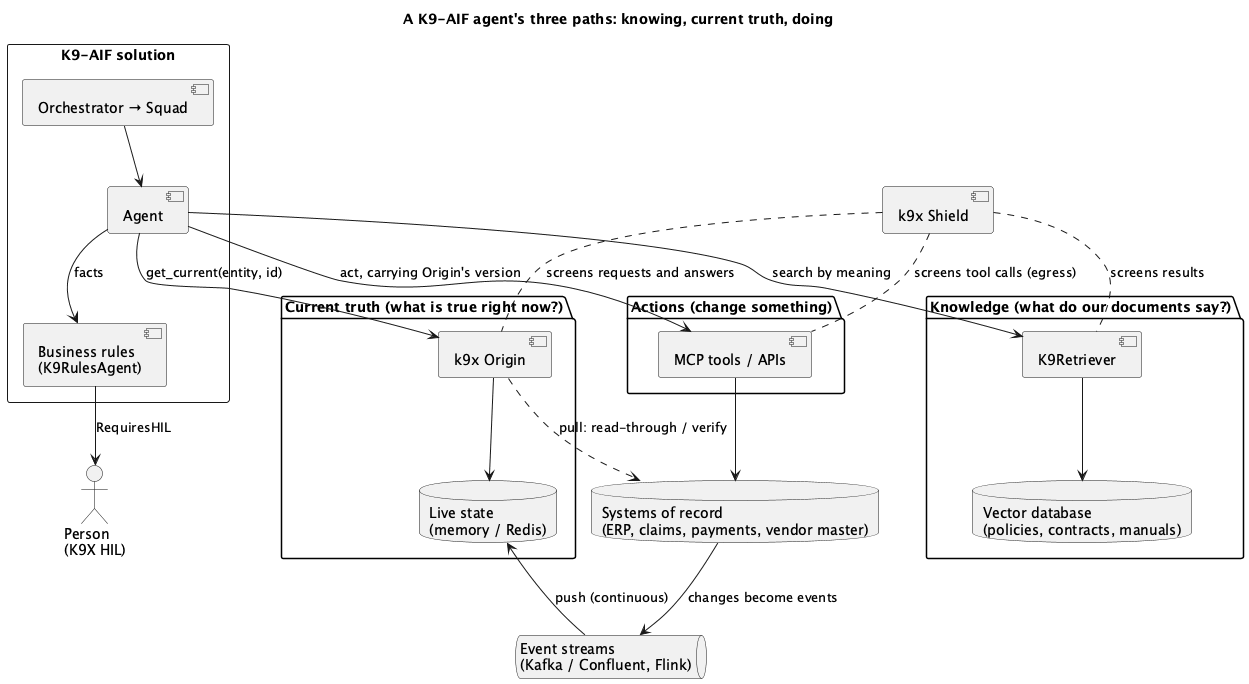
An agent's three paths: knowledge (retriever), current truth (k9x Origin), actions (systems of record), each screened by k9x Shield.
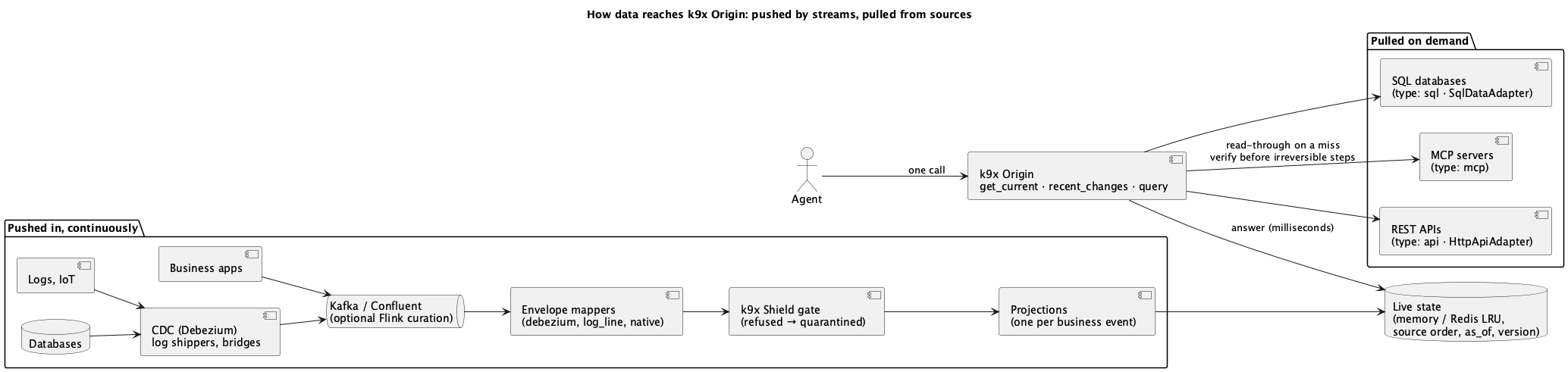
How data reaches k9x Origin: pushed by streams through the Shield gate, pulled from systems of record on demand.
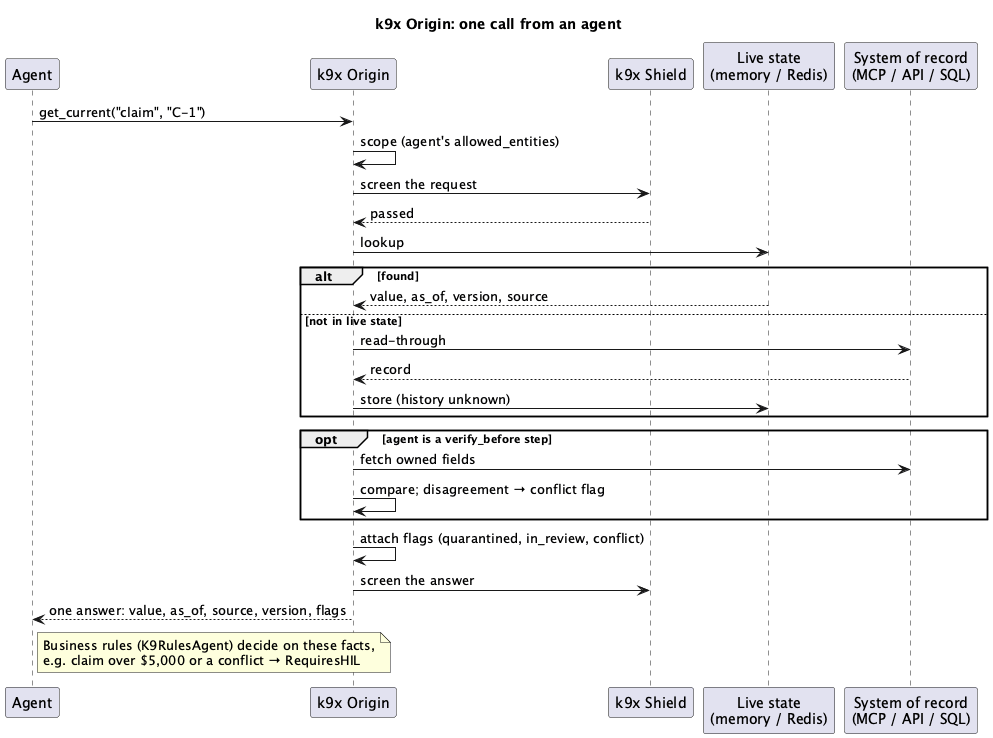
One get_current call, step by step: scope, request screening, live state or read-through, verify, flags, answer screening.
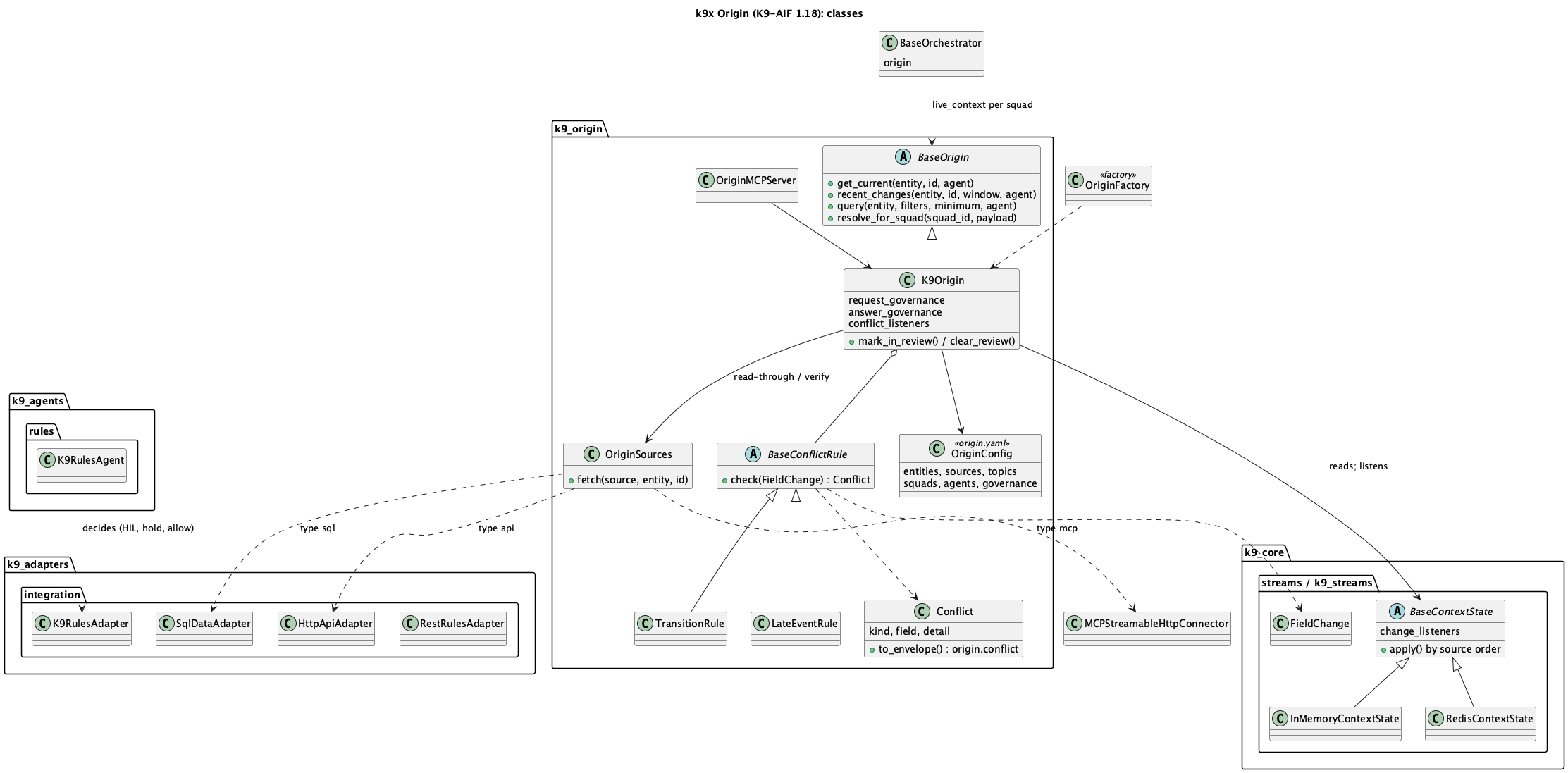
k9x Origin classes in the framework (k9_origin), with the state backends, adapters and the rules agent.
The K9X Streams application
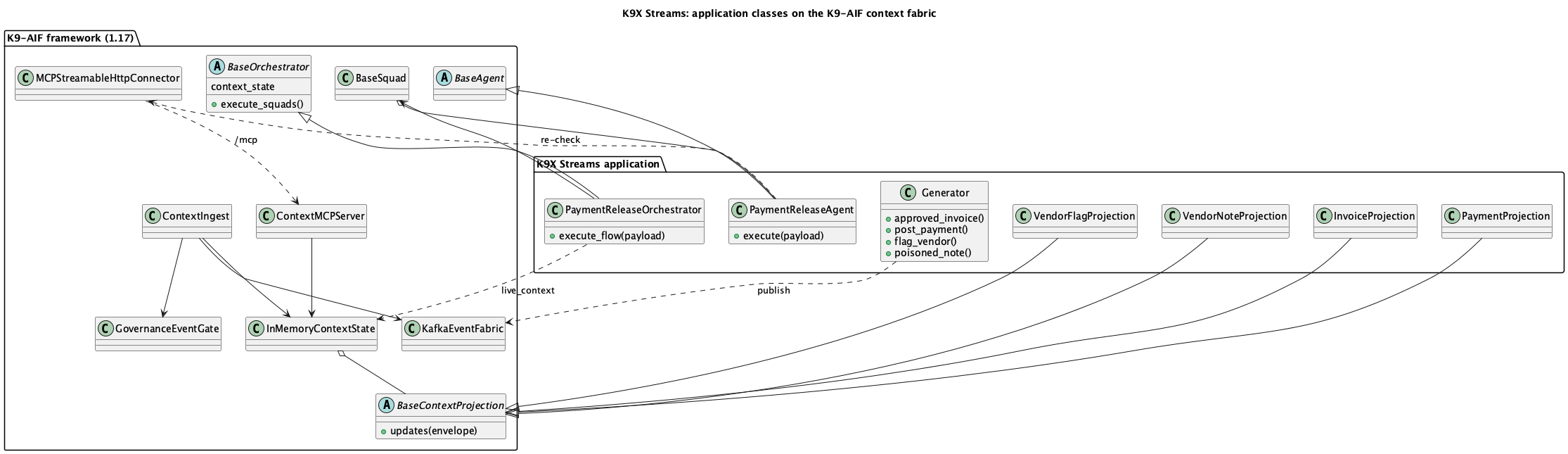
Classes: four projections, one orchestrator and one agent extend K9-AIF; everything else is the framework.
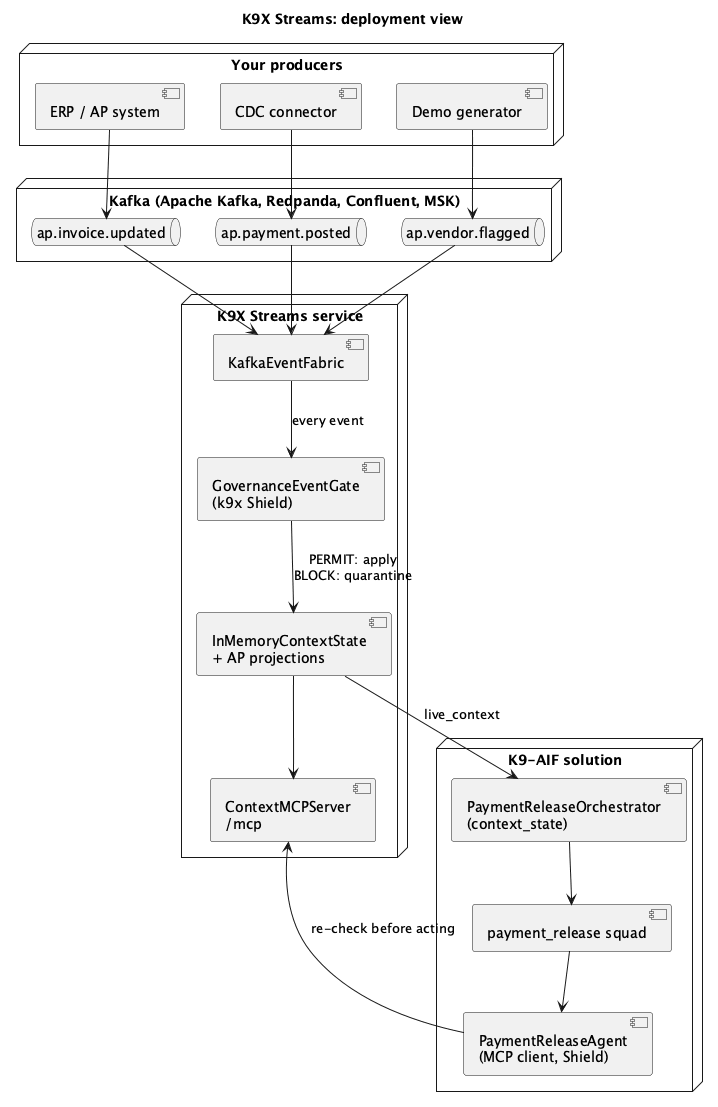
Deployment view: producers, topics, the K9X Streams service and a K9-AIF solution.
The reference model
K9X Streams is how to build an agentic application that must act on the latest information. Copy the model, not the code: your sources and your projections change; the fabric, the governance and the way agents read live context stay the same.
1 · Data sources
- Databases · change data capture
- ERP, CRM, AP, claims apps · domain events
- Application log files
- IoT devices, telemetry
- SaaS webhooks, REST APIs
- Files, batch drops, S3
- Other agents' results
2 · Kafka topics
- Apache Kafka
- Confluent Platform / Cloud
- Redpanda
- Amazon MSK
3 · K9-AIF context fabric
KafkaEventFabricGovernanceEventGate· k9x Shield; refused → quarantined- your projections → live state · as_of, version, source
- k9x Origin · one call for agents, over MCP
4 · Your K9-AIF solution
- Orchestrator · hands squads
live_context - Squad → agents
- Agent re-checks over MCP · before it pays, approves, ships
- Business rules → HIL on conflicts, quarantine, thresholds
| Source | How it reaches a Kafka topic |
|---|---|
| Relational databases (PostgreSQL, Oracle, SQL Server, MySQL) | Change data capture (Debezium on Kafka Connect): every insert, update and delete becomes an event |
| Business applications | The application publishes domain events, or its own Kafka connector does |
| Application log files | A log shipper (Fluent Bit, Vector, Filebeat) sends each line to a topic |
| IoT devices | An MQTT broker with a Kafka bridge |
| SaaS webhooks and REST APIs | A small receiver or poller publishes to a topic |
| Files and batch drops | A Kafka Connect file or S3 source connector |
| Amazon Kinesis Data Streams | A bridge connector to Kafka (Kinesis Data Firehose only delivers to storage, so agents cannot consume from it) |
Sources keep their own format: an envelope mapper per topic turns each message into an event
(debezium for database change records, log_line for application logs, or your own via
register_mapper); a webhook receiver can skip Kafka with ContextIngest.ingest_raw(). The five steps below build on it.
Five steps
k9x Origin is built into the K9-AIF framework (1.18), like k9x Shield. K9X Streams adds only its Accounts Payable projections, a generator, one orchestrator and one agent. A solution in any domain follows the same five steps.
Switch on k9x Origin
In config/config.yaml. Broker addresses and credentials stay in .env.
origin:
  enabled: true
  config: config/origin.yaml
  state: {provider: redis}        # in_memory | redis (shared, LRU-bounded)
streams:
  enabled: true                   # off: Origin answers from systems of record only
  provider: kafka
security:
  shield: {enabled: true}
Describe entities and sources
In config/origin.yaml: what agents may ask about, where each entity's system of record is, what each squad needs, and each agent's scope.
entities:
  claim:
    key: claim_id
    system_of_record: claims_api     # read-through on a miss, verify before acting
    owned_fields: [status, amount]
    conflicts: {status: {transitions: ["approved -> disapproved"]}}
sources:
  claims_api: {type: mcp, server: "${CLAIMS_MCP_URL}", tool: get_claim}
squads:
  payout: {live_context: ["claim:{claim_id}"], verify_before: [PayoutAgent]}
agents:
  PayoutAgent: {allowed_entities: [claim, policy]}
One projection per business event
Map source records to the entities your agents reason about. This is the only domain code Origin needs.
class ClaimProjection(BaseContextProjection):
    entity, id_field = "claim", "claim_id"
    def accepts(self, env): return env.event_type.startswith("claim.")
    def project(self, env): return {"status": env.payload["status"],
                                    "amount": env.payload["amount"]}
Wire it at the entry point
One factory call. Orchestrators get origin=; agents reach it over MCP with the framework's client. Production refuses an ungoverned Origin.
origin = OriginFactory.create(config, projections=[ClaimProjection()])
ContextIngest(StreamsFactory.create_fabric(config), origin.state,
              gate=StreamsFactory.create_gate(config)).attach(["claim.updated"])
orch = PayoutOrchestrator(config, governance=shield, origin=origin)
app.mount("/", OriginMCPServer(origin).http_app())      # MCP at /mcp
Decide with business rules
Origin states facts. A rules step in the squad decides, and raises a K9X HIL case when a rule says so. The agent itself makes one call: get_current("claim", "C-1").
rules_agent:
  adapter: k9_rules                  # or rest_rules (a decision service)
  hil_queue: claims-review
  rules:
    - {name: large claim,   when: "claim.amount > 5000",           then: hil}
    - {name: data conflict, when: "live_context.*.flags.conflict", then: hil}
Full recipe: Developer Guide 15.8 ↗ · design: k9x Origin design ↗
Your organization's Kafka or Confluent
K9X Streams speaks the Kafka protocol, so it connects to the broker you already run. Set it in .env; no code changes.
| Broker | Settings |
|---|---|
| Apache Kafka, Redpanda | KAFKA_BROKER=host:9092 |
| Confluent Platform | KAFKA_BROKER; plus KAFKA_SECURITY_PROTOCOL and SASL settings if your cluster requires sign-in |
| Confluent Cloud | KAFKA_SECURITY_PROTOCOL=SASL_SSL, KAFKA_SASL_MECHANISM=PLAIN, API key and secret as KAFKA_SASL_USERNAME / KAFKA_SASL_PASSWORD |
| Amazon MSK and others | SASL_SSL with SCRAM-SHA-512 (or your cluster's mechanism) |
| Your topic names | STREAMS_TOPIC_INVOICE, STREAMS_TOPIC_PAYMENT, STREAMS_TOPIC_VENDOR |
Events are JSON today; Avro with Schema Registry is next. The adapter for a broker stays a configuration choice, never a dependency: the framework stays vendor-neutral.
Security controls
Stream data and agent requests are untrusted. Each line of defence is a K9-AIF building block you configure, and each is shown working in the demo's threat simulator.
| Control | Where | Stops | Configure |
|---|---|---|---|
| Stream gate | Before live state | Planted instructions, payment diversion, PII values in events | GovernanceEventGate with PromptInjectionCheck, PaymentDiversionCheck, PIIBoundaryCheck (block_on_match) |
| Quarantine | Live state | A refused event's content ever being read | Automatic: the entity is marked quarantined; agents hold for human review |
| Entity scope | MCP server, before any read | Requests for data outside the server's domain | origin.yaml: agents.<name>.allowed_entities |
| Request screening | MCP server, before any read | Instructions in tool arguments, solicitations for PII | origin.yaml: governance.request_checks (PromptInjectionCheck, PIIRequestCheck) |
| Answer screening | MCP server and agent | PII or instructions in what an agent reads | origin.yaml: governance.answer_checks; screen_tool_result in the agent |
| Source order | Live state | A late event overwriting newer data | Automatic: events apply by when they happened; late ones are kept in history only |
| Conflict flags | Every answer | Acting on data that flipped, arrived out of order, or disagrees with its system of record | origin.yaml: entities.<name>.conflicts; business rules decide (e.g. → HIL) |
Read model, not system of record
Live state is a derived, read-only view of what is true now, rebuilt from Kafka at any time. Agents read it; they act through the systems of record, which emit events that flow back into it.
| Piece | Role |
|---|---|
| Systems of record (ERP, payments, vendor master) | Own the truth and the transactions |
| Kafka topics | Durable, ordered log of every change; use log compaction keyed by entity id for entity state |
| Live state | Derived view with as_of; eventually consistent (milliseconds to seconds) |
| Agents | Read live state; act through the system of record's API |
The agent's re-check shrinks the window for a duplicate action from hours to seconds; the final guarantee belongs in the system of record (an idempotency key or a unique constraint such as one payment per invoice).
Deploying at scale
K9-AIF scales by tier: router cluster, Kafka cluster, orchestrator clusters. K9X Streams adds three tiers that scale the same way.
| Tier | How it scales | State |
|---|---|---|
| Streams ingest workers | One consumer group; topics partitioned by entity key | Stateless: writes to the shared live state |
| Shared live state | Redis cluster, PostgreSQL, or a stream processor's materialized view | The only stateful piece; rebuildable from Kafka |
| Context MCP servers | A pool behind a load balancer | Stateless: reads the shared live state |
| Orchestrators | Existing K9-AIF clusters, each given the shared state as context_state | Stateless |
This demo runs every tier in one process with in-memory state. Shared live state in Redis
(RedisContextState, LRU-bounded, quarantine never evicted) is in K9-AIF 1.18; consumer groups with committed
offsets and lag-based freshness are next.